



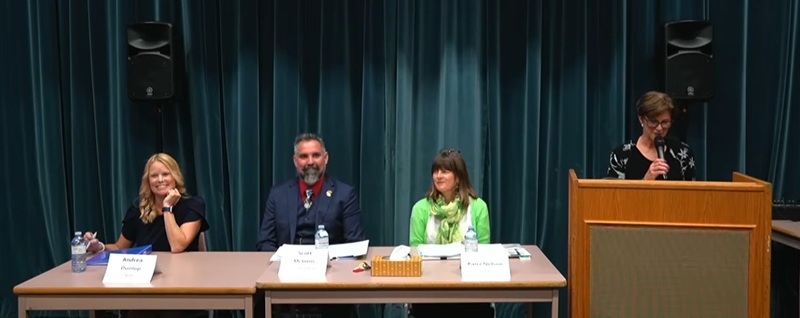
Invermere hosted a Columbia River–Revelstoke all-candidates forum Oct. 13, giving provincial election candidates an opportunity to answer community questions.
Participants were Andrea Dunlop of the BC NDP, incumbent Scott McInnis of the Conservative Party and Rana Nelson of the BC Green Party.
The candidates introduced themselves and explained why they were running before answering questions submitted by the public and prepared by the Columbia Valley Chamber of Commerce.
Topics included rural public library funding, lake stewardship, the Declaration on the Rights of Indigenous Peoples Act, forestry, the regional economy, B.C.’s financial future, housing and policies the candidates supported from other parties.
The role of public libraries in B.C. and whether funding should increase or decrease
All three candidates said public libraries play an important role in communities, particularly by providing safe spaces. Each pledged to support library funding if elected.
Lake stewardship and the provincial government’s role in managing local and shallow lakes
Dunlop said the ʔAkisq̓nuk First Nation is leading a comprehensive, science-based stewardship and management plan for Lake Windermere, which she would support.
“I would support that, ensuring that we’re making decisions on how we use our lake based on facts and on research. One of the things I really appreciated is they said not only were they going to look at the environmental impacts of those wake boats on the water, but they were also going to look at the economic impacts of the boats in our lake,” said Dunlop.
Nelson said climate change poses serious risks to lakes and waterways, making effective management essential.
“I see the government needing to manage, but I think right anybody can manage this as long as it is managed well and we are taking into account all of the impacts. And I think oversight is from any government. This isn’t just a provincial government role… It’s everybody. We all take part in our lakes, and we all benefit from them. And so we all have to be concerned about how we are protecting them and our water sources,” said Nelson.
McInnis called the issue complicated because it involves several levels of government. He said regulations should be based on clear criteria applied consistently to all lakes.
“Everybody can rest assured that the health of the lake is going to be number one in the back of everybody’s mind. The federal government plays a big role in this. And that has to do with the criteria for which, if we’re going to ban wake boating on Lake Windermere, there has to be a very clear set of criteria that’s also applied for places like Columbia Lake, Wasa Lake, and many others… I worry about a sort of one regulatory approach for one lake at a time. That simply won’t work. If we’re going to measure things based on the depth of the lake, what the carrying capacity is of the lake, it has to be something that is clear and is used across the spectrum,” said McInnis.
The Declaration on the Rights of Indigenous Peoples Act
Nelson expressed support for DRIPA, saying failure to “enact” it would mean “continuing the systemic harms that have been done to indigenous people.”
“I think so much of this is based on fear and what will happen to the lands that we have, which most of the land in BC was not from treaty; it is unceded, and that has to be addressed,” she added.
McInnis said DRIPA is not working and does “very little” for First Nations. He said he would prefer an approach based on Section 35.
“They do not get a seat at the table to discuss their prerogatives under a DRIPA mandate…DRIPA does very little to address the very serious issues in British Columbia that have to do with things like traditional territory overlap,” he said.
Dunlop emphasized the government’s position that private property “would not be threatened” under DRIPA.
“We need good faith government-to-government negotiations that clarify how land and resources are managed. That is how we build trust, respect, rights, and create the certainty we need to invest in our future,” she said.
Forestry sector
The candidates discussed the effect of U.S. tariffs on forestry and stressed the need to support workers.
McInnis said the Conservative Party would accelerate permitting and cut red tape, arguing there is “no reason” applicants should wait two years for a cutting permit.
Dunlop called for better forest management, including more people working in forests to identify resources and areas requiring protection. She said increased logging alone would not solve the sector’s problems.
Nelson echoed Dunlop’s call for improved forest management. She also advocated for adapting practices to forest types and local conditions across the province.
How would you support local businesses, strengthen existing industries and build a more resilient regional economy?
Dunlop supported the NDP plan to work with the federal government to attract investment in major B.C. projects. She also backed efforts to find non-U.S. markets for B.C. products.
Nelson said helping local and regional businesses grow is important. She pointed to the Greens’ proposal to create manufacturing and industrial opportunities in communities across the province.
McInnis said the Conservative Party would invest $500 million in three areas to help communities through wildfire season. The plan includes a B.C.-operated firefighting aircraft, proactive forest management, commercial thinning and prescribed burns around communities, and a $100-million innovation fund for earlier wildfire protection, which he says will “ inherently improve” careers in the business sector.
Balancing social services, tax resistance and the high cost of living to secure B.C.’s financial future
Nelson said the Greens’ propose a one-time wealth tax on households worth at least $50 million to fund education, health care, child care, housing and other urgently needed social services.
McInnis cited the Conservative Party’s proposal to raise the provincial income tax threshold from $13,000 to $32,000. He also supported developing natural gas as a transitional fuel produced cleanly, efficiently and ethically.
Dunlop said fiscal responsibility differs from fiscal conservatism. She said the deficit reflects spending on school construction, highway repairs, hospital upgrades and child-care centres.
Reliable funding for stalled rural affordable housing projects
McInnis said involving the private sector in properly regulated non-market housing projects would deliver homes more quickly and at lower cost.
Dunlop pointed to the NDP’s housing investments and existing non-market projects across the province. She said she would meet with the organizations and local governments behind stalled projects and take their concerns directly to the housing authority and ministry.
Nelson said government can build housing more affordably than private contractors. She cited the Greens’ Fair Share Act, which would assess wealth and apply a progressive tax to help cover costs.
A policy from another party each candidate supports
Dunlop said she supports the Green Party’s position on proportional representation and a serious review of electoral reform. She said first-past-the-post does not always reflect the range of views expressed at the ballot box and stressed the importance of working with other parties when they have good ideas.
Nelson identified the NDP’s long-term care homes as a policy she supports, calling them a priority for seniors who need housing. She said the community’s challenges are non-partisan and that residents want homes, jobs and safe places to live.
McInnis said he supports Greens’ investment in provincial parks, recreation sites and trails. He also backed wage increases for early childhood educators, calling them “hardworking” and the raises “long overdue.” He said he would support those policies if elected.
The forum concluded with closing remarks from each candidate. To watch the full forum, visit the Columbia Valley Chamber of Commerce’s YouTube page.
Final voting day in the provincial election is Oct. 24.
Voting locations are available on the Elections BC website.
Opinions are of those attributed and information from individuals has not been fact-checked.





Comments